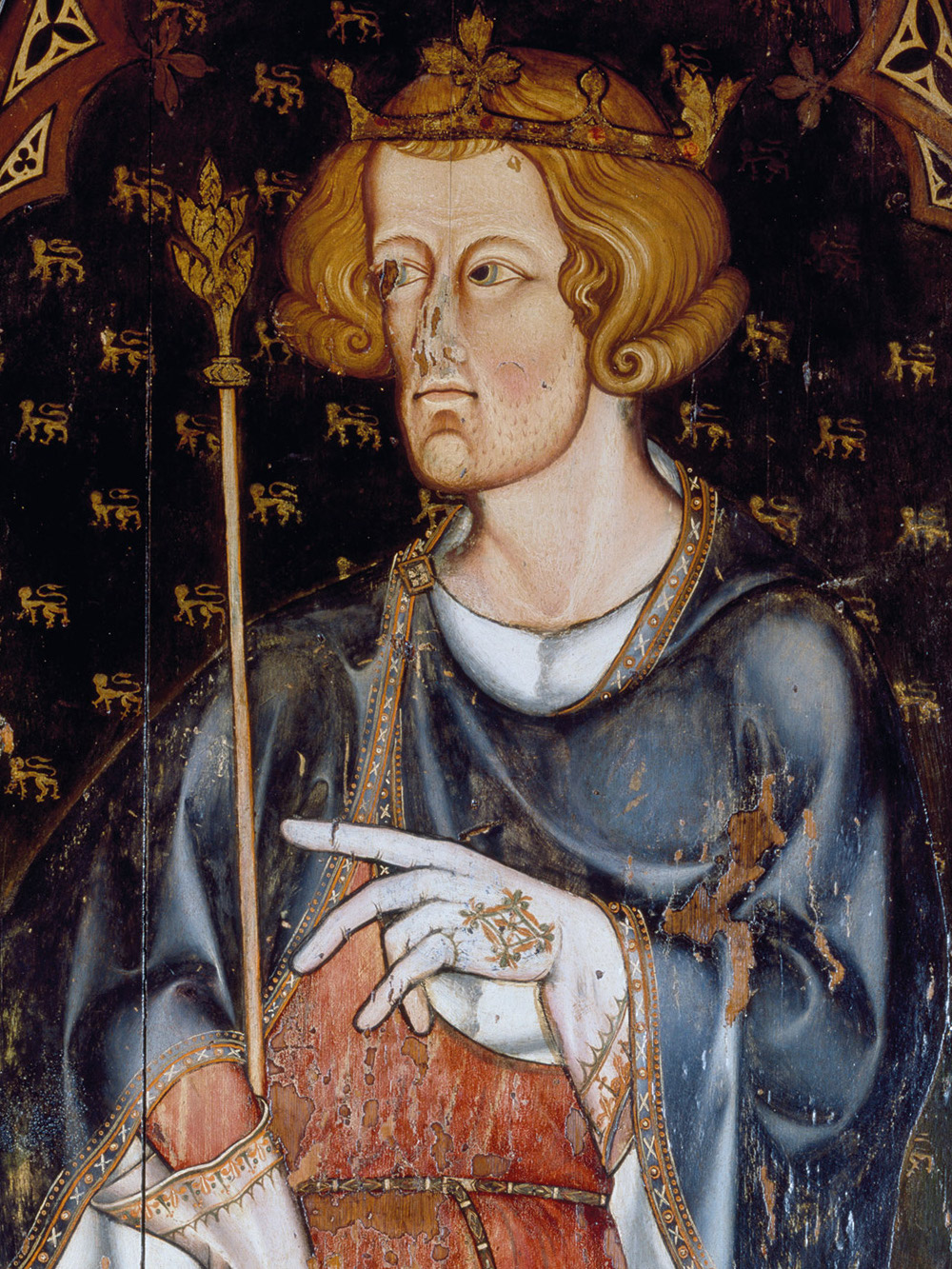
Edward I becomes king of England
Edward I becomes king of England following the death of his father Henry III of England
Edward I (17/18 June 1239 – 7 July 1307), also known as Edward Longshanks and the Hammer of the Scots (Latin: Malleus Scotorum), was King of England from 1272 to 1307. Concurrently, he was Lord of Ireland, and from 1254 to 1306 ruled Gascony as Duke of Aquitaine in his capacity as a vassal of the French king. Before his accession to the throne, he was commonly referred to as the Lord Edward.
The eldest son of Henry III, Edward was involved from an early age in the political intrigues of his father's reign. In 1259, he briefly sided with a baronial reform movement, supporting the Provisions of Oxford. After reconciling with his father, he remained loyal throughout the subsequent armed conflict, known as the Second Barons' War. After the Battle of Lewes, Edward was held hostage by the rebellious barons, but escaped after a few months and defeated the baronial leader Simon de Montfort at the Battle of Evesham in 1265. Within two years, the rebellion was extinguished and, with England pacified, Edward left to join the Ninth Crusade to the Holy Land in 1270. He was on his way home in 1272 when he was informed of his father's death. Making a slow return, he reached England in 1274 and was crowned at Westminster Abbey.
Edward spent much of his reign reforming royal administration and common law. Through an extensive legal inquiry, he investigated the tenure of several feudal liberties. The law was reformed through a series of statutes regulating criminal and property law, but the King's attention was increasingly drawn towards military affairs. After suppressing a minor conflict in Wales in 1276–77, Edward responded to a second one in 1282–83 by conquering Wales. He then established English rule, built castles and towns in the countryside and settled them with English people. After the death of the heir to the Scottish throne, Edward was invited to arbitrate a succession dispute. He claimed feudal suzerainty over Scotland and invaded the country, and the ensuing First Scottish War of Independence continued after his death. Simultaneously, Edward found himself at war with France (a Scottish ally) after King Philip IV confiscated the Duchy of Gascony. The duchy was eventually recovered but the conflict relieved English military pressure against Scotland. By the mid-1290s, extensive military campaigns required high levels of taxation and this met with both lay and ecclesiastical opposition in England. In Ireland, he had extracted soldiers, supplies and money, leaving decay, lawlessness and a revival of the fortunes of his enemies in Gaelic territories. When the King died in 1307, he left to his son Edward II a war with Scotland and other financial and political burdens.
Edward's temperamental nature and height (6 ft 2 in, 188 cm) made him an intimidating figure. He often instilled fear in his contemporaries, although he held the respect of his subjects for the way he embodied the medieval ideal of kingship as a soldier, an administrator, and a man of faith. Modern historians are divided in their assessment of Edward; some have praised him for his contribution to the law and administration, but others have criticised his uncompromising attitude towards his nobility. Edward is credited with many accomplishments, including restoring royal authority after the reign of Henry III and establishing Parliament as a permanent institution, which allowed for a functional system for raising taxes and reforming the law through statutes. At the same time, he is often condemned for vindictiveness, opportunism and untrustworthiness in his dealings with Wales and Scotland, coupled with a colonialist approach to their governance and to Ireland, and for antisemitic policies leading to the 1290 Edict of Expulsion, which expelled all Jews from England.
Edward I (17/18 June 1239 – 7 July 1307), also known as Edward Longshanks and the Hammer of the Scots (Latin: Malleus Scotorum), was King of England from 1272 to 1307. Concurrently, he was Lord of Ireland, and from 1254 to 1306 ruled Gascony as Duke of Aquitaine in his capacity as a vassal of the French king. Before his accession to the throne, he was commonly referred to as the Lord Edward.
Edward was born on the night of 17–18 June 1239 at the Palace of Westminster, to King Henry III and Eleanor of Provence. Edward, an Anglo-Saxon name, was not commonly given among the aristocracy of England after the Norman Conquest, but Henry was devoted to the veneration of Edward the Confessor and decided to name his firstborn son after the saint. Edward's birth was widely celebrated at the royal court and throughout England, and he was baptised three days later at Westminster Abbey. He was commonly referred to as the Lord Edward until his accession to the throne in 1272. Among his childhood friends was his cousin Henry of Almain, son of King Henry's brother Richard of Cornwall. Henry of Almain remained a close companion of the prince for the rest of his life. Edward was placed in the care of Hugh Giffard – father of the future Chancellor Godfrey Giffard – until Bartholomew Pecche took over at Giffard's death in 1246. The details of Edward's upbringing are unknown, but he received an education typical of an aristocratic boy his age, including in military studies.
There were concerns about Edward's health as a child, and he fell ill in 1246, 1247, and 1251. Nonetheless, he grew up to become a strong, athletic, and imposing man. At 6 ft 2 in (188 cm) he towered over most of his contemporaries, hence his epithet "Longshanks", meaning "long legs" or "long shins". The historian Michael Prestwich states that his "long arms gave him an advantage as a swordsman, long thighs one as a horseman. In youth, his curly hair was blond; in maturity it darkened, and in old age it turned white. The regularity of his features was marred by a drooping left eyelid ... His speech, despite a lisp, was said to be persuasive."